

Cultivated meat could help reduce the food system's climate impact, but its success hinges on renewable energy. Without renewables, its carbon footprint may surpass chicken or pork. However, when powered by solar or wind, it emits far less CO₂ than beef and pork and matches chicken in efficiency.
Key points:
- Energy demand: Cultivated meat requires more energy than livestock farming.
- Renewables matter: Solar and wind power can cut emissions by up to 92% compared to beef.
- Land use: It uses up to 90% less land than livestock, opening opportunities for reforestation.
- Scaling challenges: High energy needs for reactors and culture media production remain hurdles.
The bottom line? Renewable energy is the linchpin for cultivated meat to become a low-impact alternative to traditional farming.
Research Findings on Renewable Energy and Cultivated Meat
Major Studies and Projections
Recent studies have taken a closer look at how renewable energy impacts the environmental footprint of cultivated meat production. In January 2023, Sinke et al. (CE Delft) examined a commercial-scale facility capable of producing 10,000 tonnes annually. Using data from over 15 companies, they found that cultivated meat is almost three times more efficient than chicken at converting crops into meat, thanks to a continuous and staggered production process [1].
In April 2026, Bene Meat Technologies conducted a life cycle assessment based on their industrial-scale facility. Using data from their pilot plant and a 2024 Czech electricity mix, they calculated a carbon footprint of 4.7 kg CO₂ eq. and a cumulative energy demand of 79.7 MJ per kilogram of cultivated meat. When they modelled a "2030+" scenario with a 30% increase in solar energy, the footprint dropped to 3.3 kg CO₂ eq. and 61.5 MJ [3]. These findings highlight how renewable energy can significantly reduce the environmental impact of cultivated meat production.
The studies also pinpointed two major energy-intensive processes: maintaining reactor temperatures at 37°C and producing culture medium ingredients biotechnologically. These areas are critical in determining the overall sustainability of cultivated meat [1]. Such insights provide a clearer understanding of how renewable energy integration can amplify environmental benefits.
Environmental Benefits of Renewable Energy Integration
The data shows that incorporating renewable energy into cultivated meat production has tangible environmental benefits. Decarbonising the energy supply directly reduces emissions. Life cycle assessments reveal that, with renewable energy, when comparing cultivated meat vs. traditional meat, the former has a smaller carbon footprint than beef and pork and is on par with the most efficient conventional meat, chicken [1]. Additionally, cultivated meat powered by renewables requires less agricultural land and results in lower nitrogen-related emissions, thanks to its superior feed conversion efficiency [6]. This is particularly relevant given the significant land use associated with traditional livestock farming.
"Cultivated meat, when produced at scale, can offer a comparable or lower environmental footprint than conventional chicken, particularly when key inputs and energy sources are optimised." – Bene Meat Technologies [3]
The research makes it clear: renewable energy is indispensable. Without it, cultivated meat could end up with a higher carbon footprint than pork or chicken [6]. These findings emphasise the role of renewable energy in making cultivated meat a genuinely sustainable alternative.
sbb-itb-c323ed3
Valeti on the environmental benefits of cell-cultivated meat
Comparing Energy Sources: Renewable vs Conventional
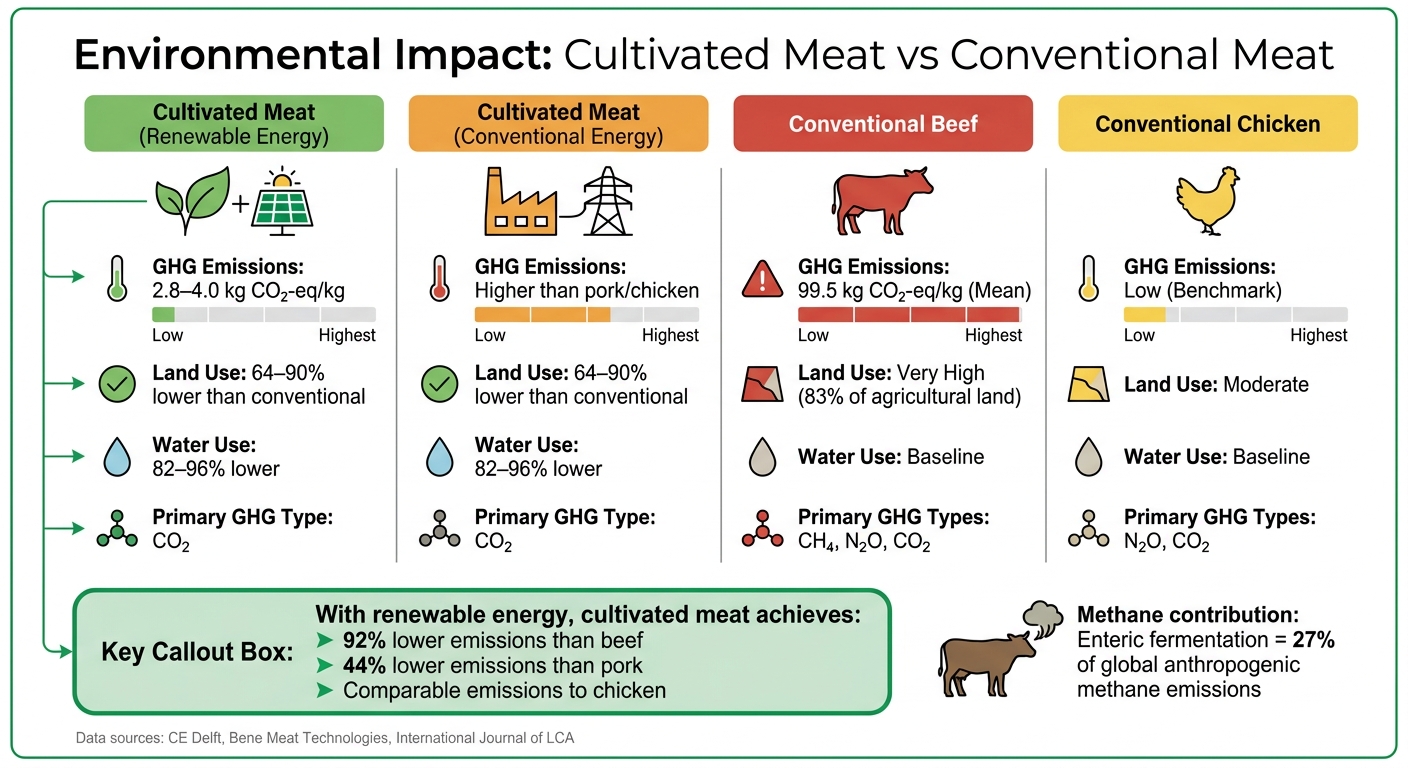
Carbon Footprint Comparison: Cultivated Meat vs Conventional Meat by Energy Source
Environmental Metrics and Comparisons
This section delves into how energy sources impact the environmental performance of cultivated meat, building on earlier insights about renewable energy's advantages.
The energy source - renewable or conventional - plays a key role in determining whether cultivated meat can fulfil its potential to reduce environmental harm. The energy mix significantly influences the carbon footprint of its production [7].
When cultivated meat production relies entirely on renewable energy, its carbon footprint falls between 2.8 and 4.0 kg CO₂ eq. per kilogram [8]. This marks a reduction of up to 92% compared to conventional beef and 44% lower than pork [8]. However, when using a conventional global energy mix, while cultivated meat still has a smaller footprint than beef, it surpasses pork and chicken in emissions [7].
The type of emissions also varies significantly. Cultivated meat primarily emits CO₂ due to energy use, whereas conventional livestock generates substantial quantities of methane (CH₄) from enteric fermentation and nitrous oxide (N₂O) from manure management [7]. Notably, enteric fermentation alone contributes 27% of global anthropogenic methane emissions [7].
The table below highlights these differences, which you can also explore using a cultivated meat sustainability calculator:
| Metric | Cultivated Meat (Renewable Energy) | Cultivated Meat (Conventional Energy) | Conventional Beef (Beef Herd) | Conventional Chicken |
|---|---|---|---|---|
| GHG Emissions (kg CO₂-eq/kg) | 2.8–4.0 [8] | Higher than pork/chicken [7] | 99.5 (Mean) [5] | Low (Benchmark) [7] |
| Land Use | 64–90% lower [8] | 64–90% lower [8] | Very High (83% of ag land) [7] | Moderate [7] |
| Primary GHG Type | CO₂ [7] | CO₂ [7] | CH₄, N₂O, CO₂ [7] | N₂O, CO₂ [7] |
| Water Use Reduction | 82–96% lower [9] | 82–96% lower [9] | Baseline | Baseline |
Cultivated meat offers a clear advantage in terms of land use efficiency. Its production requires significantly less agricultural land, reducing nitrogen-related emissions since the process is contained and does not involve manure [7]. This efficiency makes it a promising alternative to traditional livestock farming.
Future Outlook: Scaling and Renewable Energy Adoption
Scaling up production of cultivated meat promises better energy efficiency but also brings its own set of challenges. Moving from lab-scale experiments to full-scale commercial production is a critical step in fulfilling cultivated meat's potential to reduce environmental impact. For example, as facilities expand to industrial operations - like running multiple 10,000-litre stirred-tank reactors simultaneously - energy efficiency improves significantly [1][7]. When paired with the decarbonisation of power grids, cultivated meat could achieve a carbon footprint as low as 2 kg CO₂ equivalent per kilogram if powered entirely by renewable energy sources [11].
This potential is already being realised in real-world projects. Bene Meat Technologies (BeneMeat) is set to open an industrial-scale facility in the Czech Republic by late 2025, with a daily production capacity of 400 to 600 kg of cultivated meat. Covering around 3,000 m², the facility will utilise on-site photovoltaic panels, which could supply up to 30% of the energy needed for production [3]. Life cycle assessments of this facility suggest that by optimising inputs and using a post-2030 electricity mix, the environmental impact could drop to 3.3 kg CO₂ equivalent and 61.5 MJ of cumulative energy demand per kilogram of product [3].
To tackle the technical challenges of scaling up, advancements in reactor designs and culture medium formulations are essential. Managing energy demands across multiple production lines is particularly complex. A single facility producing 10,000 tonnes annually might need around 130 production lines running simultaneously [1]. These innovations are paving the way for addressing both the environmental benefits and the technical obstacles of scaling up.
Opportunities for Carbon Sequestration
The land-saving potential of cultivated meat goes beyond reducing emissions. By freeing up agricultural land, there’s an opportunity for reforestation and biodiversity restoration. Livestock currently occupies 83% of global agricultural land while contributing just 18% of the world’s calories [7]. Transitioning away from traditional livestock farming could lead to large-scale ecosystem recovery. This highlights the importance of renewable energy in maximising the environmental gains of cultivated meat.
"Governments should consider this emerging industry's increased renewable energy demand and the sustainability potential of freed-up agricultural land." – The International Journal of Life Cycle Assessment [7]
The repurposed land could sequester more carbon than the emissions generated by cultivated meat production [10]. With cultivated meat being 2.8 to 5.8 times more efficient at converting feed into meat than conventional livestock [10], the land-use savings grow as production scales. This creates a dual advantage: reduced direct emissions and increased carbon capture through land restoration.
Challenges in Scaling Renewable Energy for Cultivated Meat
Despite the opportunities, significant hurdles remain in scaling renewable energy to meet the demands of cultivated meat production. The process is energy-intensive, especially for maintaining reactor temperatures and producing the biotechnological ingredients required for the culture medium [1]. Without renewable energy, the carbon footprint of cultivated meat could rival or even exceed that of efficiently produced conventional chicken [7].
Another challenge lies in the underdeveloped supply chain for specialised equipment, such as stainless steel tanks and electromotors [1][3]. Meeting the growing demand for cultivated meat - especially with global meat consumption projected to rise by over 70% by 2050 compared to 2010 levels [7] - requires significant investment in renewable energy infrastructure and manufacturing capabilities. To navigate these hurdles, many companies are starting with pet food production, where regulatory barriers are lower. This approach allows them to refine industrial-scale production before entering human food markets [3]. Overcoming these challenges will play a key role in shaping policy and managing consumer expectations.
Policy and Consumer Implications
Supporting Renewable Energy Through Policy
Policy plays a crucial role in ensuring cultivated meat meets its potential for reducing environmental impact. The carbon footprint of cultivated meat varies significantly depending on the energy source - ranging from 25 kg CO₂-eq per kilogram when powered by fossil fuels to just 2 kg CO₂-eq per kilogram with renewable energy sources[11]. This stark contrast highlights the importance of policies that prioritise expanding renewable energy infrastructure.
"Governments should consider this emerging industry's increased renewable energy demand and the sustainability potential of freed-up agricultural land." – The International Journal of Life Cycle Assessment[2]
In the UK, hybrid solar–wind plants are expected to play an increasing role in supporting sustainable protein production. By 2050, electricity costs for these systems are projected to drop significantly, from around £17–20 per MWh in 2030 to £10–12 per MWh[12]. This makes it essential for policymakers to account for the industry's energy requirements when planning the national grid. Additionally, clear regulatory frameworks are key to driving progress. For instance, in June 2023, the U.S. Department of Agriculture approved the sale of cultivated chicken products by California-based companies Upside Foods and Good Meat, marking a significant step forward. Initially available through partner restaurants, these products are expected to reach retail markets soon[4]. Such regulatory advancements not only accelerate production but also encourage investments in renewable energy.
Another opportunity lies in the potential for repurposing agricultural land. Switching to cultivated meat could free up vast areas, which could then be used for reforestation or carbon sequestration. This shift opens the door for governments to craft land-use policies that maximise environmental benefits while promoting renewable energy adoption. Together, these measures can transform energy infrastructure and boost consumer trust in the industry.
Consumer Awareness and Education
While supportive policies lay the groundwork, consumer understanding is essential for driving demand for cultivated meat produced sustainably. A 2023 poll revealed that 50% of U.S. adults are hesitant to try cultivated meat due to safety concerns compared to conventional meat[4]. Educational initiatives can help address these doubts by explaining how renewable energy significantly reduces the environmental impact of cultivated meat, reinforcing its sustainability advantages.
Platforms like Cultivated Meat Shop offer UK consumers reliable, science-based information about this emerging food category. They emphasise the environmental benefits of cultivated meat, showing how its carbon footprint can drop from 25 kg CO₂-eq to just 2 kg CO₂-eq per kilogram when renewable energy is used[11]. By providing clear insights and comparisons to conventional meat - especially high-impact options like beef and pork[2] - these efforts build trust and position cultivated meat as a viable, eco-friendly alternative.
Conclusion
Research highlights that renewable energy is the key factor in determining whether cultivated meat can meet its environmental potential. When produced with conventional energy sources, its carbon footprint is considerably higher, but switching to renewable energy can bring it down to approximately 2–3 kg CO₂-eq per kilogram[8].
The emissions from cultivated meat are mainly direct energy emissions (Scope 1 and 2), which can be significantly reduced by adopting renewable power. This makes cultivated meat distinct from conventional livestock, where emissions like methane from enteric fermentation - responsible for 27% of global anthropogenic methane emissions - are much harder to mitigate[2].
"As countries around the world are putting strong efforts into decarbonising their electricity grid, the GHG impacts of cultivated meat will decrease. Less so for conventional agriculture: a reduction of the release of methane from cows and GHG from agricultural soils are far more difficult to achieve."[13]
Beyond cutting carbon emissions, there’s potential to reclaim the 83% of global agricultural land currently used for livestock[2]. This could open up opportunities for reforestation, carbon storage, and restoring biodiversity. Industrial-scale facilities are already adopting on-site renewable energy, demonstrating that these concepts are becoming a reality[3].
Realising this vision requires collaboration. Policymakers need to expand renewable energy infrastructure and find new uses for agricultural land[2]. Producers should focus on using low-carbon energy and refining culture media ingredients. Meanwhile, consumers - encouraged by platforms like Cultivated Meat Shop - should see cultivated meat as a direct replacement for high-impact conventional meat, rather than an additional choice[2].
Renewable energy has the power to turn cultivated meat into a sustainable alternative. As the UK continues to decarbonise its electricity grid, this transformation will strengthen cultivated meat’s role as a low-impact, environmentally friendly option to replace traditional meat.
FAQs
How much renewable energy does cultivated meat production require?
Producing cultivated meat requires a considerable amount of renewable energy. However, estimates suggest that energy use could drop by anywhere from 7% to 45% compared to traditional meat production methods. Achieving these reductions hinges on advancements in technology and improved efficiency, showing the potential for cultivated meat to emerge as a more eco-friendly alternative to conventional farming practices.
What are the biggest energy hotspots in cultivated meat factories?
The biggest energy requirements in cultivated meat production stem from cell cultivation and bioreactor operation. These steps demand substantial energy to maintain precise conditions, such as temperature regulation, agitation, and a steady supply of nutrients.
Switching to renewable energy sources can drastically cut down the environmental impact, particularly since bioreactor operations consume the bulk of the energy. Boosting energy efficiency and integrating more renewable energy into the process are crucial steps towards making production more sustainable.
Will the land saved by cultivated meat be reforested?
The production of cultivated meat requires up to 99% less land compared to traditional livestock farming. This drastic reduction in land use opens up opportunities for reforestation, which can play a key role in addressing deforestation and promoting the preservation of biodiversity.


