

Meat production is at a crossroads. Traditional farming feeds billions but is resource-heavy and contributes significantly to greenhouse gas emissions. Bioreactors, used for cultivated meat, offer an alternative by growing meat directly from animal cells. But how do these two systems compare when it comes to emissions, land use, water consumption, and energy demands?
Key Takeaways:
- Emissions: Farming emits methane (short-lived but potent), while bioreactors emit CO2 (long-lasting). Cultivated meat could cut emissions dramatically but depends on renewable energy and efficient growth media.
- Land Use: Farming takes up 60% of agricultural land yet provides less than 2% of global calories. Bioreactors need far less space.
- Water Use: Meat-heavy diets double the water footprint compared to plant-based diets. Bioreactors use less water but depend on media preparation.
- Energy Needs: Bioreactors are energy-intensive, requiring advanced infrastructure and renewable energy for lower impact.
Quick Comparison:
| Metric | Farming | Bioreactors |
|---|---|---|
| Emissions | Methane (~12 years atmospheric life) | CO2 (centuries-long atmospheric life) |
| Land Use | High: 4 billion hectares | Low: Compact industrial facilities |
| Water Use | High: Crop irrigation, livestock hydration | Lower: Media preparation, cooling |
| Energy Use | Moderate (machinery, fertiliser) | High: Stirring, heating, sterilisation |
Both systems have pros and cons. Farming's methane emissions are short-lived but significant, while bioreactors shift the burden to CO2 due to energy demands. Scaling up cultivated meat with renewable energy and efficient media could make it a viable alternative to current methods. Consumer choices and regulatory support will play a major role in shaping the future of meat production.
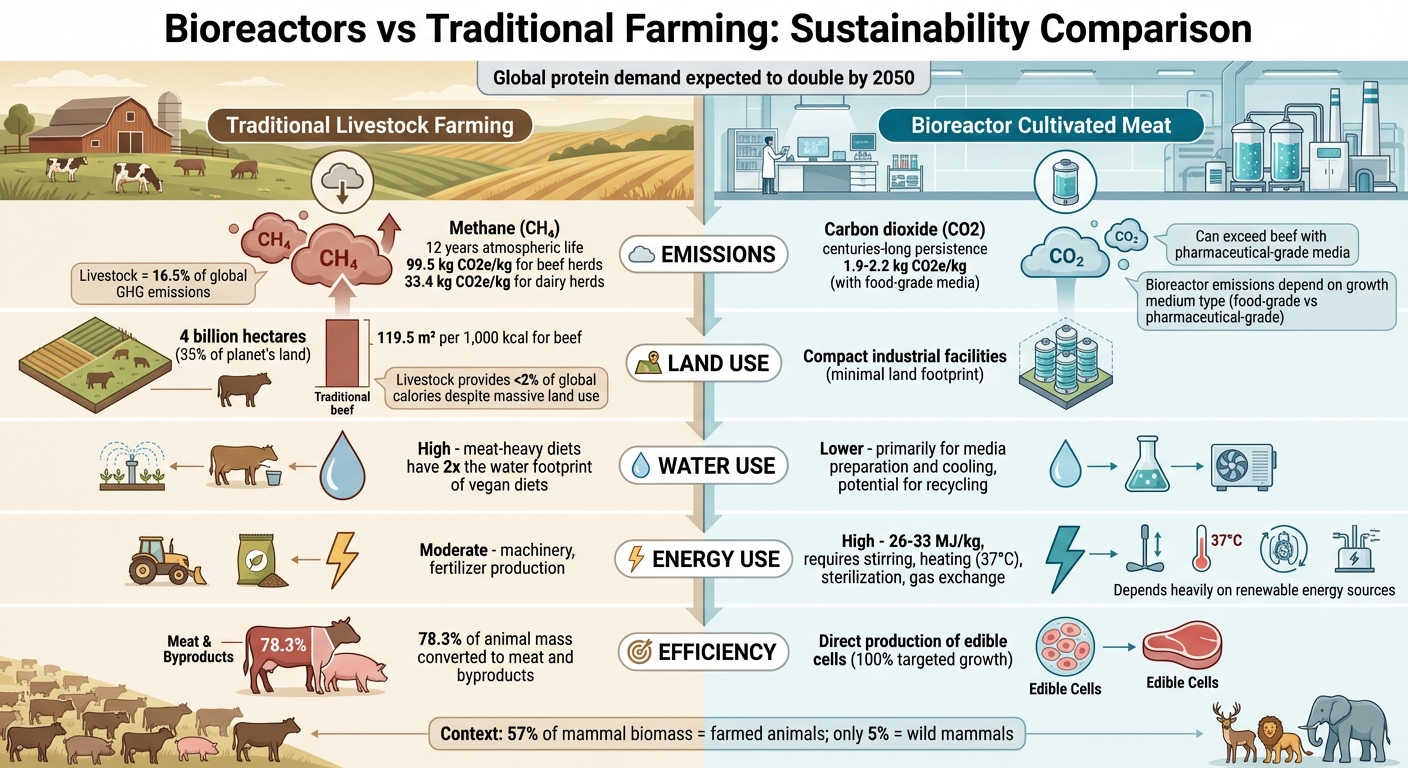
Bioreactors vs Traditional Farming: Environmental Impact Comparison
Traditional Livestock Farming: Environmental Impact
Carbon Emissions from Livestock
Traditional livestock farming contributes to climate change through the release of methane, nitrous oxide, and carbon dioxide. Each of these gases impacts the environment in different ways.
Methane, for example, is mainly released during the digestion process of ruminants like cows and sheep, as well as through manure management. While methane remains in the atmosphere for about 12 years, it has a much stronger warming effect during that time. As John Lynch and Raymond Pierrehumbert from the University of Oxford explain:
Per molecule, methane results in significantly greater radiative forcing than carbon dioxide, but has an atmospheric lifespan of only around 12 years... in contrast to the millennial persistence of carbon dioxide [1].
Nitrous oxide, on the other hand, comes from fertilisers and manure. This gas can linger for more than a century and has a much higher warming potential per molecule than both methane and CO2 [1]. Carbon dioxide emissions arise from activities like deforestation to create pastures or grow animal feed, as well as from the use of fossil fuels in farm machinery and fertiliser production.
Livestock farming accounts for at least 16.5% of global greenhouse gas emissions [2]. The emissions vary depending on the farming system. For instance, Brazilian pasture-raised beef generates 42.45 kg of CO2-equivalent per kilogram, while intensive systems in the USA Midwest produce 43.7 kg. The difference lies in the emission sources: Brazilian systems release more methane due to slower animal growth, whereas intensive American systems emit higher levels of CO2 and nitrous oxide due to heavy reliance on inputs [1].
But emissions are only part of the story - traditional farming also places a heavy burden on natural resources.
Resource Use in Traditional Farming
Livestock farming demands vast amounts of land and water. It occupies about 35% of the planet's land area - roughly 4 billion hectares - yet contributes less than 2% of the global calorie supply [2].
The inefficiency becomes stark when comparing land use for producing 1,000 kilocalories. Beef requires 119.5 m², while tofu needs just 1.3 m² and potatoes only 0.9 m² [2]. Expanding "regenerative" or extensive grazing systems would require 2.5 times the current land use - approximately 10 billion hectares, which is almost half of Earth's total land area [2].
Water use follows a similar pattern. Diets high in meat consumption have nearly double the water footprint of vegan diets [2]. A significant portion of this water is used to grow feed crops, which take up large areas of arable land that could otherwise produce food directly for people.
The impact extends beyond emissions and resource use. Traditional farming contributes to biodiversity loss, with 57% of all mammal biomass now made up of farmed animals, while wild mammals account for only 5% [2]. Michael Grunwald illustrates this stark reality:
When you eat a burger, you're not just eating a cow. You're eating macaws and jaguars and the rest of the cast of Rio. You're eating the Amazon. You're eating the earth [2].
These resource demands highlight the environmental challenges that cultivated meat production seeks to address.
Large Scale Cultivated Meat Bioreactors (Ark Biotech)
Bioreactors and Cultivated Meat Production
Bioreactors provide a controlled environment for growing animal cells, offering a way to bypass many of the environmental downsides tied to traditional farming. Let’s dive into how these systems can cut carbon emissions, improve resource efficiency, and tackle energy-related hurdles.
Carbon Emission Reductions
Bioreactor-based production avoids methane emissions from livestock digestion and manure management, two major sources of greenhouse gases in conventional beef farming [3].
Edward S. Spang and colleagues highlight the environmental toll of traditional beef production:
The environmental impact of beef production includes greenhouse gas emissions (GHGs) from enteric fermentation and manure, nutrient loading in the nitrogen and phosphorus cycles, reduction in biodiversity from overgrazing, and deforestation from land-use change [3].
Early life cycle studies show that cultivated meat could produce just 1.9 to 2.2 kg of CO2e per kilogram, compared to conventional beef’s staggering range of 9.6 to 432 kg of CO2e per kilogram, with an average of 99.5 kg CO2e/kg for beef cattle [3].
However, bioreactors shift emissions from methane, a short-lived gas, to carbon dioxide, which persists much longer in the atmosphere due to the energy-intensive nature of their operation. One study even found:
In some scenarios, cultured meat production increased global temperatures more than beef production and this was largely due to the limited atmospheric life of methane [3].
The emission profile also depends heavily on the growth medium. Using food-grade rather than pharmaceutical-grade components is key to keeping emissions lower than traditional beef [3]. With over $3 billion invested in cell-based meat technology, researchers are working to refine its environmental and economic potential [3]. But hitting emission reduction targets will require renewable energy and streamlined production methods.
Resource Usage Efficiency
Bioreactors need significantly less land than traditional farming, which relies on vast areas for grazing and feed crop cultivation [3]. Instead, bioreactor facilities are compact industrial buildings that can be set up wherever utilities are available.
This efficiency stems from focusing solely on growing edible tissue. Unlike farming whole animals - where much of the biomass isn’t used for food - bioreactors target muscle and fat cells directly. For context, only about 78.3% of a farmed animal’s mass is used for meat and byproducts [3].
Water use also drops dramatically. Bioreactors primarily consume water for the growth medium and operational needs, avoiding the irrigation demands of feed crops. Additionally, their smaller land footprint helps preserve forests and ecosystems, which are often cleared for pasture or cropland - significant contributors to carbon emissions in traditional farming [3].
That said, energy use remains a significant obstacle.
Energy Use and Current Challenges
Energy consumption is a major environmental challenge for bioreactor systems. These facilities require energy for mechanical stirring, gas exchange, heat regulation, and sterilisation [4]. Maintaining mammalian cells at 37°C adds to this already high energy demand [4].
Different reactor designs impact energy use. Stirred-tank reactors rely on mechanical impellers, while airlift reactors use bubbling to mix the medium, becoming more efficient at larger scales - typically beyond 20,000 litres [4]. Scaling up further to bioreactors of 262,000 litres could improve both cost and resource efficiency compared to the smaller pharmaceutical-scale vessels, which usually max out at 25,000 litres [3].
Single-use systems can cut energy costs by removing the need for heated sterilisation between batches, though this creates more plastic waste [4]. Continuous processing methods offer another solution, potentially reducing capital and operating costs by 55% over a decade compared to batch processing [4].
Still, several technical challenges remain. Achieving high cell densities - over 1 × 10⁸ cells/ml - along with developing affordable, low-impact amino acid supply chains, is critical [3]. Additionally, animal cells are highly sensitive to impurities, requiring tailored growth media for each cell type [3].
With global protein demand expected to double by 2050 [3], advancing bioreactor technology and transitioning to renewable energy sources will be essential. These improvements are key to making cultivated meat a viable, lower-impact alternative to conventional livestock farming.
sbb-itb-c323ed3
Bioreactors vs Traditional Farming: Direct Comparison
Key Sustainability Metrics
When comparing sustainability metrics side by side, it becomes clear that traditional farming and bioreactors each come with their own set of advantages and challenges. Let’s break it down further to understand these systems' environmental impacts.
Traditional beef farming emits an average of 99.5 kg CO2e per kilogram for beef herds and 33.4 kg CO2e per kilogram for dairy herds. On the other hand, early studies on cultivated meat projected emissions as low as 1.9–2.2 kg CO2e per kilogram, but these estimates relied on hypothetical feedstocks like cyanobacteria [3]. The actual emissions for cultivated meat are highly dependent on the type of growth medium used. As researchers at UC Davis pointed out:
"The environmental impact of near-term ACBM production has the potential to be significantly higher than beef if a highly refined growth medium is utilized for ACBM production." [3]
When pharmaceutical-grade media is used, cultivated meat can produce more emissions than conventional beef. However, using food-grade media could bring emissions below those of traditional farming. The type of medium is a crucial factor in determining whether cultivated meat offers a genuine environmental advantage [3].
Another key difference is the type of emissions. Traditional farming primarily produces methane, which breaks down in about 12 years, while bioreactors emit mostly carbon dioxide, which lingers in the atmosphere for centuries. The table below summarises the main sustainability metrics for both systems:
| Metric | Traditional Livestock (Beef) | Bioreactor (Cultivated Meat) |
|---|---|---|
| Primary Emission Source | Methane from enteric fermentation and manure [3] | Carbon dioxide from energy use and media production [3] |
| Carbon Footprint (Mean) | 99.5 kg CO2e/kg (beef herd); 33.4 kg CO2e/kg (dairy herd) [3] | Emissions can exceed beef with pharmaceutical-grade media; lower with food-grade media [3] |
| Land Use | High: Requires extensive grazing areas, feed crop production, and contributes to deforestation [3] | Low: Requires compact industrial facilities [3] |
| Water Use | High: Significant amounts needed for hydration of livestock and crop irrigation [3] | Variable: Depends on media preparation and cooling, with potential for recycling [3] |
| Waste Generation | Nutrient pollution from manure and fertiliser runoff [3] | Waste from spent growth media [3] |
| Atmospheric Persistence | Methane (short-lived, ~12 years) [3] | Carbon dioxide (long-lasting, persists for centuries) [3] |
Traditional farming processes convert about 78% of an animal’s mass into meat, while bioreactors directly produce edible cells [3]. Cultivated meat's energy consumption is estimated at 26–33 MJ per kilogram, but achieving this efficiency depends on scaling up production and transitioning to renewable energy sources [3].
These comparisons highlight the complexities involved in assessing the environmental impact of meat production and set the stage for a deeper understanding of how consumer choices could shape the future of food.
Consumer Choices and the Future of Meat
Considering Cultivated Meat
Shifting to Cultivated Meat is a gradual process, but the choices consumers make can significantly speed things up. Surveys reveal that 16% to 41% of Britons are open to trying Cultivated Meat - a number that has steadily increased over the past seven years. According to the Food Standards Agency (FSA), 59% of consumers acknowledge the benefits of Cultivated Meat for animal welfare and the environment. However, 85% still express concerns about its safety, its perceived unnatural qualities, and how it might affect traditional farming methods [5]. Interestingly, consumer perceptions are described as "changeable", meaning that the way information is presented - whether it highlights sustainability, safety, or regulatory oversight - can greatly shape their willingness to give Cultivated Meat a try [5].
"The most important predictors of consumption intentions are believing that there are any benefits of cell-cultivated meat and feeling confident in regulation." - Food Standards Agency [5]
Regulatory approval from trusted bodies like the FSA seems to carry more weight with consumers than labels such as "slaughter-free" or "carbon-neutral." This makes the UK government’s £1.6 million investment in the FSA’s safety programme, launched in March 2025, a major step towards building public trust [5]. As these perceptions evolve, they directly influence demand, laying the groundwork for more sustainable meat production methods. Consumer interest in sustainable options highlights the importance of exploring alternatives like Cultivated Meat.
How Cultivated Meat Shop Supports Consumers
In the journey towards a more balanced and sustainable food system, informed decisions are key. That’s where Cultivated Meat Shop steps in. As the world’s first consumer-focused platform for Cultivated Meat, it acts as a trusted resource for anyone curious about this new food category. The platform breaks down how Cultivated Meat is made, compares it to traditional farming, and outlines its environmental advantages.
Cultivated Meat Shop provides educational materials and previews of upcoming products, keeping consumers in the loop. It serves as a guide to understanding this technology, preparing people for a future where meat production is more sustainable.
Conclusion
Bioreactors present a promising way to tackle the environmental challenges tied to traditional beef production, which is notorious for its high emissions and resource demands. Conventional livestock farming places immense pressure on land use and contributes significantly to methane emissions [3]. In contrast, Cultivated Meat, grown in industrial-scale bioreactors, sidesteps these issues entirely.
The key to making Cultivated Meat a viable alternative lies in creating sustainable, food-grade growth media. While hurdles still exist, this technology addresses many of the environmental drawbacks of traditional farming. With global protein demand expected to double by 2050 [3], finding sustainable solutions has become increasingly urgent. As noted by ACS Food Science & Technology [3]:
"Producing sustainable and healthy protein is emerging as one of the key challenges of our century, especially considering estimates that the global demand for protein will double by 2050."
This highlights the importance of consumer choices in driving a shift toward sustainability. As regulations evolve and production scales up, Cultivated Meat offers a practical way to reduce the environmental impact of livestock farming. Making informed decisions now can help accelerate this transition.
For those eager to learn more about how Cultivated Meat contributes to a sustainable food future, Cultivated Meat Shop offers educational resources and product insights to keep you updated as this technology progresses.
FAQs
Will cultivated meat still be greener if bioreactors use fossil electricity?
Cultivated meat tends to have a smaller environmental impact compared to traditional farming, primarily because it requires less land and water. However, its carbon footprint isn't fixed - it heavily depends on the energy used. If non-renewable sources power the process, emissions can increase significantly. Shifting to renewable energy for running bioreactors could make a big difference, cutting down emissions even further.
Why is the growth medium so important for Cultivated Meat emissions?
The growth medium is a major factor in the emissions associated with cultivated meat production. It directly influences both energy consumption and the carbon footprint. Key elements like its composition and sourcing can affect energy-heavy processes such as manufacturing and purification. By opting for more sustainable culture media and incorporating renewable energy sources, emissions can be significantly reduced. This makes the growth medium a crucial element in efforts to make cultivated meat production more environmentally friendly.
How close is cultivated meat to scaling up without high energy use?
Cultivated meat is moving closer to being produced on a commercial scale, but one major hurdle remains: its high energy requirements, particularly for running bioreactors. Compared to traditional farming, it does have the advantage of using far less land and water. However, the energy demand is still a challenge. That said, switching to renewable energy sources could significantly lower its environmental footprint. With ongoing improvements in technology and efficiency, the path to producing cultivated meat sustainably at a large scale is becoming clearer.


