

Cultivated meat offers a new way to produce meat while avoiding methane emissions from livestock. Methane, a greenhouse gas, is much more effective at trapping heat than carbon dioxide but breaks down in about 12 years. Livestock farming, especially cattle, produces 27% of human-caused methane emissions, making it a major contributor to climate change.
Cultivated meat eliminates methane emissions by growing animal cells in bioreactors instead of raising animals. While the process primarily emits carbon dioxide due to energy use, switching to renewable energy can reduce greenhouse gas emissions by up to 92%. It also uses 90% less land and is three times more efficient than chicken farming.
Key points:
- Livestock farming contributes significantly to global methane emissions.
- Cultivated meat avoids methane by skipping animal digestion.
- Renewable energy is critical to maximising its climate benefits.
- It requires significantly less land and water than conventional farming.
This shift could greatly reduce agriculture's impact on global warming, but scaling up production and improving energy efficiency are key to its success.
Methane Emissions from Livestock Farming
Why Methane Accelerates Climate Change
Methane is a powerful greenhouse gas, trapping much more heat per molecule than carbon dioxide, especially in the short term [1][6]. While CO₂ can linger in the atmosphere for centuries, methane breaks down in about 12 years [1][2][6]. This short lifespan, combined with its intense warming ability, means methane has a significant impact on near-term temperature increases.
To capture its full effect, climate models often amplify methane's warming potential by a factor of 1.45. This adjustment accounts for secondary effects, like the production of stratospheric water vapour and changes to ozone levels [1]. Because of these dynamics, cutting methane emissions can lead to relatively quick climate benefits, unlike CO₂, which accumulates over time.
These characteristics underline the importance of accurately measuring methane emissions from livestock.
How Much Methane Livestock Produces
Given methane's potency, it's vital to understand the role livestock farming plays in its release.
Ruminants, such as cattle, are significant methane producers. They emit the gas during enteric fermentation, a digestive process where microbes break down their feed [3][6]. Additionally, methane is released from manure storage, making livestock farming a major contributor to global methane emissions.
The scale of these emissions is striking. Beef production alone accounts for 25% of all emissions linked to food production, while livestock farming as a whole is responsible for 57% of food-related emissions [5].
"To produce more meat you need to feed the animals more, which then generates more emissions. You need more biomass to feed animals in order to get the same amount of calories. It isn't very efficient." - Xiaoming Xu, Lead Author, Nature Study [5]
How Cultivated Meat Eliminates Methane Emissions
Growing Meat Without Animals
Cultivated meat is created by growing animal cells in controlled bioreactors, completely skipping the digestive processes in livestock that produce methane through enteric fermentation.
This method is incredibly efficient, with a production cycle lasting just two to eight weeks - a fraction of the 18 to 36 months it takes to raise cattle. During this time, animal stem cells multiply in a nutrient-rich medium, forming muscle tissue without the metabolic activities that generate methane. This animal-free approach ensures that methane emissions are nearly eliminated.
"Cultured meat emissions are almost entirely CO₂ from energy generation." - John Lynch, Atmospheric Physicist, University of Oxford
Near-Zero Methane Output
Since cultivated meat production relies on controlled processes rather than animal digestion, methane emissions are practically non-existent. Unlike traditional cattle farming, which produces a mix of methane, nitrous oxide, and carbon dioxide, cultivated meat facilities primarily emit carbon dioxide from the energy required to power bioreactors.
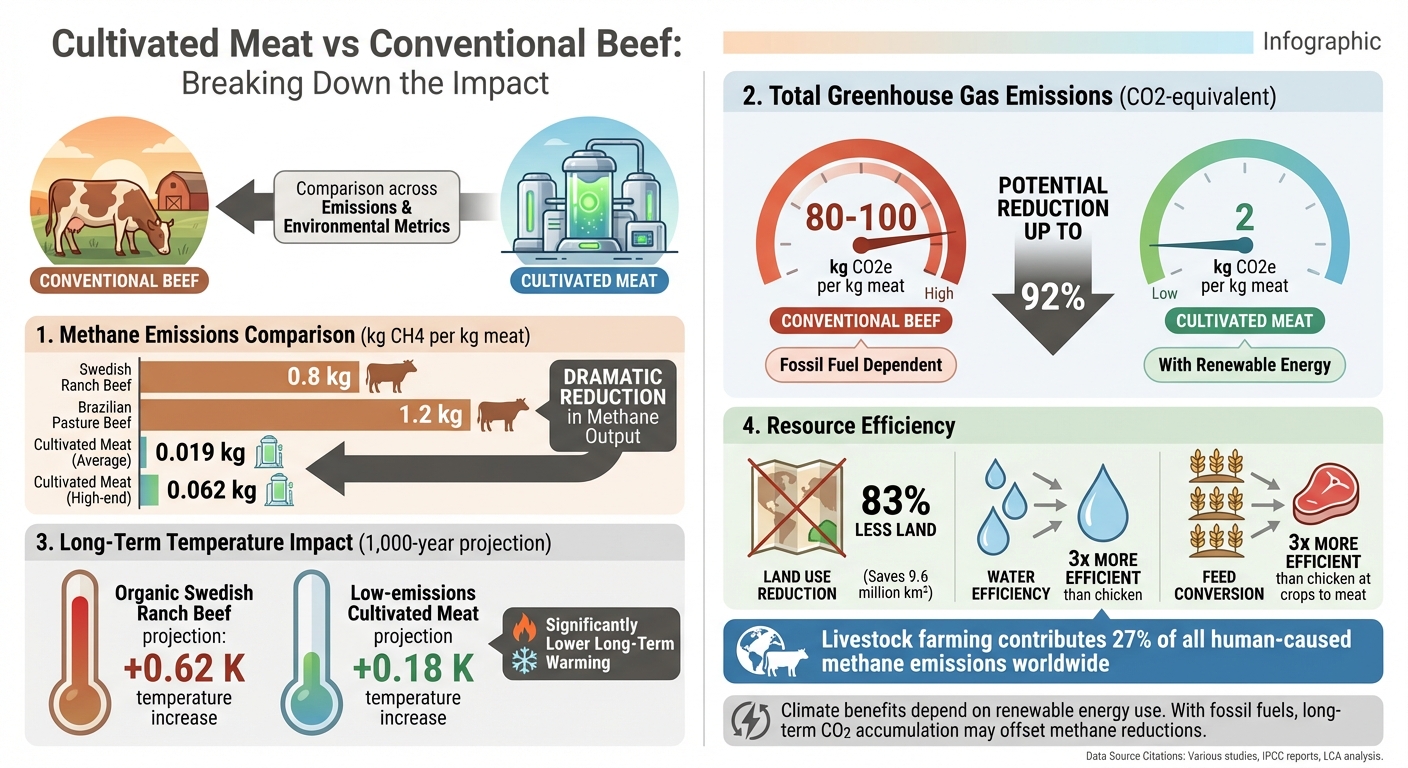
When renewable energy is used, cultivated meat production could slash greenhouse gas emissions by up to 92% compared to conventional beef.
This shift from methane - a potent but short-lived greenhouse gas - to carbon dioxide offers a tangible way to reduce agriculture's immediate impact on global warming, especially as energy grids become greener.
Lab-Grown Meat: How Much Can It Help Save Our Climate? | WSJ Tech News Briefing
sbb-itb-c323ed3
What Research Shows About Methane Reduction
Cultivated Meat vs Conventional Beef: Emissions and Resource Comparison
Life Cycle Assessment Studies
Life cycle assessments (LCAs) offer a detailed look at how cultivated meat stacks up against traditional livestock when it comes to methane emissions. A 2023 study analysed a 10,000-tonne-per-year cultivated meat facility and found that, when powered by renewable energy, its carbon footprint is far lower than beef and comparable to efficient, intensive chicken farming [3].
Traditional beef production is a major emitter of greenhouse gases, releasing methane, nitrous oxide, and carbon dioxide. Methane alone accounts for about 50% of the total emissions from beef production [8]. Research led by John Lynch at the University of Oxford highlights the difference: in a high-emissions scenario for cultivated meat, methane output is just 0.062 kg per kilogram of meat, compared to 0.8–1.2 kg per kilogram for conventional beef [1].
| Production System | CO2 (kg/kg meat) | CH4 (kg/kg meat) | GWP100 (CO2e) |
|---|---|---|---|
| Swedish Ranch Beef | 0.90 | 0.8 | 28.6 |
| Brazilian Pasture Beef | 0.90 | 1.2 | 42.45 |
| Cultivated Meat (Average) | 6.64 | 0.019 | 7.5 |
| Cultivated Meat (High-end) | 22.1 | 0.062 | 25.0 |
These findings provide a solid foundation for evaluating the long-term climate implications of producing cultivated meat.
Long-Term Climate Impact Models
Looking beyond immediate emissions, long-term climate models emphasise how crucial energy sources are for cultivated meat's overall environmental impact. Thanks to its nearly negligible methane emissions, cultivated meat shows clear advantages over cattle farming when renewable energy is used.
"Cultured meat is not prima facie climatically superior to cattle; its relative impact instead depends on the availability of decarbonized energy generation and the specific production systems that are realised."
In a 1,000-year climate projection, a low-emissions cultivated meat system resulted in a temperature increase of +0.18 K, compared to +0.62 K for organic Swedish ranch beef [6]. However, if cultivated meat production relies on fossil fuels, its cumulative CO₂ emissions could eventually outweigh the short-term benefits gained from eliminating methane [1][6].
Global Methane Reduction Potential
The potential to reduce global methane emissions is immense. Enteric fermentation from ruminant livestock contributes 27% of all human-caused methane emissions worldwide [3]. In the UK, agricultural methane accounts for 49% of the nation's total methane emissions, with 85% of this coming from enteric fermentation [9].
When powered by renewable energy, cultivated meat produces just 2 kg of CO2-equivalent per kilogram of meat, compared to the 80–100 kg of CO2-equivalent generated by conventional beef [8]. Furthermore, cultivated meat is roughly three times more efficient than chicken - the most efficient traditional livestock - at converting crops into meat. This not only reduces methane emissions but also lowers the broader environmental impact of feed production [3].
Other Environmental Benefits of Cultivated Meat
Lower Land and Water Requirements
Cultivated Meat has the potential to drastically reduce land use compared to traditional farming methods. Currently, animal agriculture takes up a staggering 83% of all global agricultural land, including pastures and cropland for animal feed. By 2050, a complete shift to Cultivated Meat could slash this land requirement by 83%, freeing up an estimated 9.6 million km² [7][10].
"CM is almost three times more efficient in turning crops into meat than chicken, the most efficient animal, and therefore agricultural land use is low." - Sinke et al., The International Journal of Life Cycle Assessment [7]
One of the main reasons for this efficiency is the elimination of grazing, which accounts for 84% of the land used for livestock [10]. While Cultivated Meat production does require crop inputs like glucose (often derived from maize) for the cell culture medium, the demand for these crops is far lower than for conventional livestock farming. To put it in perspective, 65% of the world’s maize is currently used for animal feed, but producing glucose for Cultivated Meat would only require about 6% of global arable land [10].
Water use also sees dramatic savings. Conventional livestock farming consumes 41% of the world’s water resources, whereas Cultivated Meat systems are designed to recycle water efficiently. With three times the water efficiency of chicken - the most efficient source of conventional meat - Cultivated Meat significantly reduces the water needed for both production and crop irrigation [3].
These resource savings not only highlight the efficiency of Cultivated Meat but also contribute to its ability to lower overall greenhouse gas emissions.
Reduced Greenhouse Gas Emissions Overall
Cultivated Meat offers a substantial reduction in greenhouse gas emissions by addressing two major sources: nitrous oxide from animal manure and carbon dioxide from land-use changes [3][6]. Currently, animal agriculture is responsible for approximately 16.5–19.4% of global greenhouse gas emissions [3].
| Environmental Indicator | Cultivated Meat Potential Impact | Conventional Livestock Context |
|---|---|---|
| Land Use | 83% reduction [10] | Occupies 83% of global agricultural land [3] |
| GHG Emissions | 52% annual reduction [10] | Contributes ~16.5–19.4% of global GHGs [3] |
| Phosphorus Demand | 53% reduction [10] | High demand for feed crop fertilisers [10] |
| Nitrogen Emissions | Substantially lower [3] | Over one-third of anthropogenic nitrogen emissions [3] |
What's Next for Cultivated Meat and Climate Goals
Cultivated meat has the potential to nearly eliminate methane emissions, but this depends on scaling the technology alongside the decarbonisation of energy grids. The shift from traditional livestock farming to cultivated meat represents a major transformation - from methane-heavy emissions caused by animal digestion to emissions linked primarily to energy consumption. As a result, the pace at which energy grids transition to renewable sources becomes the most critical factor in determining whether cultivated meat can deliver long-term climate benefits. Several key factors will influence how effectively this transition contributes to climate goals.
Factors That Will Affect Climate Impact
The environmental impact of cultivated meat is tightly linked to the energy sources used in its production. As John Lynch from the University of Oxford points out, the climate advantage of this technology relies on renewable energy and the specific systems used in its production [1]. Without clean energy, the potential to significantly reduce methane emissions could be undermined.
Scaling up production - from pilot phases to commercial levels of around 10,000 tonnes annually - will require improvements in energy efficiency and significant reductions in the cost of culture media. Currently priced at hundreds of pounds per litre, these costs need to drop to approximately £1 per litre to be commercially viable [4]. Additionally, producers must adopt more sustainable feedstocks, such as soy or grain hydrolysates, to minimise their environmental footprint further [7].
For cultivated meat to make a meaningful dent in global methane emissions, it must replace high-impact products like beef and lamb, rather than simply becoming another protein option on supermarket shelves [7].
How You Can Support This Change
Although cultivated meat isn’t yet available in the UK, there are steps you can take to prepare for its arrival and support its environmental promise. Stay informed by visiting Cultivated Meat Shop for resources, product updates, and waitlist opportunities. In the meantime, consider reducing your consumption of methane-intensive meats like beef and lamb. Ruminants, such as cattle and sheep, are responsible for 27% of global methane emissions caused by human activity [7]. By making these changes and supporting advancements in cultivated meat, you can play a part in addressing methane-driven climate challenges.
FAQs
How does cultivated meat help reduce greenhouse gas emissions compared to traditional farming?
Cultivated meat comes with a much smaller greenhouse gas footprint compared to traditional livestock farming. Unlike conventional methods, which generate significant methane (CH₄) emissions through processes like enteric fermentation and manure decomposition, cultivated meat sidesteps these emissions entirely. Plus, it uses far fewer resources, such as land and water, which helps to further lower its overall environmental impact.
Livestock farming plays a major role in driving climate change, contributing methane and nitrous oxide (N₂O) emissions, alongside carbon dioxide (CO₂) from deforestation and the use of fossil fuels. Cultivated meat offers a different approach by growing real meat directly from animal cells, eliminating the need for raising animals and the emissions that come with it. This positions it as a promising option for building a food system that’s kinder to the planet.
How does renewable energy impact the sustainability of cultivated meat production?
The sustainability of cultivated meat hinges heavily on the type of energy used in its production. By relying on renewable energy sources like wind and solar power, the greenhouse gas emissions associated with cultivated meat can be dramatically reduced. This makes it a far more climate-friendly option compared to traditional meat farming.
On the other hand, if fossil fuels are the primary energy source, the production process risks becoming energy-intensive and less environmentally sound. To truly deliver on its promise as an eco-conscious alternative, the cultivated meat industry needs to prioritise the adoption of renewable energy. This approach not only aligns with global climate goals but also ensures that cultivated meat remains a viable and greener choice compared to conventional livestock farming.
What are the environmental advantages of choosing cultivated meat?
Opting for cultivated meat brings notable benefits for the environment, particularly in cutting down greenhouse gas emissions. Traditional livestock farming is a significant contributor to methane and nitrous oxide emissions - two powerful greenhouse gases that accelerate climate change. In contrast, cultivated meat production is designed to generate far fewer emissions, especially methane, while using resources more efficiently.
Another key advantage is the minimal land required for producing cultivated meat. Unlike conventional farming, it eliminates the need for expansive grazing areas or growing feed crops. This reduction in land use helps prevent deforestation and cuts down on carbon dioxide emissions caused by land use changes. By embracing cultivated meat, we can reduce the environmental toll of meat production and take a crucial step in addressing climate change.


