

If I had to sum this up in one line: cultivated chicken is usually the first product brands take into new markets because it feels familiar, fits everyday meals, and is simpler to trial than beef, pork, or seafood.
I can see the same pattern across Cultivated Meat Shop, GOOD Meat, UPSIDE Foods, SuperMeat and Vital Meat. The article shows that brands keep starting with chicken because:
- people already know how chicken should taste and look
- restaurants can add it to menus with few changes
- early products work well as nuggets, mince, burgers, shredded meat, and hybrid foods
- first launches have happened in places with regulatory updates and approval already in place, such as Singapore and the US
- price, scale, and shopper understanding still limit repeat buying
A few numbers make the point fast:
- Singapore approved cultivated chicken in December 2020
- the US followed in June 2023
- GOOD Meat 3 sells at S$7.20 for 120 g
- about 26% of UK consumers are open to including cultivated meat in their diet
- fewer than 2% of UK consumers correctly understand what cultivated meat means
- one review found 65.3% would try it, but only 31.5% would eat it often instead of farmed meat
Singapore to house Asia's largest cultivated chicken meat facility
sbb-itb-c323ed3
Quick comparison
| Brand | Main angle | First-use format | Route to market | Main takeaway |
|---|---|---|---|---|
| Cultivated Meat Shop | UK consumer education | Fillets, nuggets, mince | Information first | Chicken is the easiest product to explain |
| GOOD Meat | Early approved brand | Nugget-style bites, shredded hybrid chicken | Restaurants, then retail | Familiar food helps first trial |
| UPSIDE Foods | US launch through chefs | Chicken dishes, processed formats | Restaurant first | Chicken lowers the barrier for diners |
| SuperMeat | Tasting-led foodservice model | Burgers, mince, breaded items | Test kitchen, then partners | Familiar menu items help first use |
| Vital Meat | B2B ingredient model | Hybrid chicken for ravioli, soups, nuggets, patties | Ingredient supply first | Chicken works well as an ingredient before full retail launch |
So if you want the short answer, here it is: chicken moves first because it is the lowest-friction option for brands, kitchens, and shoppers. The article then shows how each company applies that idea in a slightly different way, as seen in these cultivated chicken brand comparisons.
1. Cultivated Meat Shop
Cultivated Meat Shop is a UK-based consumer education platform, not a manufacturer. Its job is simple: help shoppers understand cultivated meat in practical, everyday terms.
That framing helps explain why chicken is often the easiest first product to introduce in new markets.
Product Familiarity
The platform explains cultivated chicken in plain English: real chicken grown from animal cells, not a plant-based substitute. It uses guides and FAQs, then links the idea to familiar British meals like a Sunday roast, chicken tikka masala, or a chicken sandwich from a high-street chain.
That matters. People don't just need to know what cultivated chicken is. They need to picture where it sits in daily life.
Side-by-side comparisons, such as cultivated chicken breast versus conventional chicken breast, also help keep the category recognisable and easy to grasp.
Menu Fit
Cultivated Meat Shop presents cultivated chicken as a like-for-like ingredient that can slot into existing recipes with little or no change. It refers to standard UK portion sizes of 150–200 g per adult and includes cooking guidance in °C, which makes the product feel practical rather than futuristic.
The platform also points out that early products are more likely to appear in processed formats, including:
- Nuggets
- Mince
- Fillets
So instead of starting with whole cuts, the first wave is framed around formats shoppers already know well.
Shopper Appeal
Cultivated Meat Shop speaks to a few likely audience groups: meat-eaters who care about the planet, health-focused shoppers worried about antibiotics and food poisoning, early-adopter food fans, and families who want familiar, convenient meals.
UK awareness is still low, and most consumers still say they would not pay more than they do for conventional meat. That helps explain the platform's education-first tone.
Visitors can also join a waitlist and register interest in specific product types, such as cultivated chicken fillets or nuggets. That gives the platform a simple way to see which formats UK shoppers find most appealing.
GOOD Meat takes a similar chicken-first route, but with a production-led brand story.
2. GOOD Meat
GOOD Meat, a brand under Eat Just, uses cultivated chicken as its first product for new markets. It was also the first cultivated meat company cleared for sale anywhere in the world, after Singapore approved its cultivated chicken in December 2020. [3][7] That makes GOOD Meat a useful example of how cultivated chicken can enter new markets.
Market-Entry Strategy
GOOD Meat took a foodservice-first, retail-later route. It started in Singapore restaurants, then moved into delivery and retail. In the US, it entered restaurant service after approval in 2023. [3][7][12]
That approach made sense because the product was familiar from the start. People already know chicken. They know how it looks, how it tastes, and how it fits into a meal. So the company did not need to teach diners a whole new food category at the same time as it introduced a new production method.
Product Familiarity
GOOD Meat uses its own cultivated-meat brand, which helps avoid confusion with JUST Egg. [5][10] Early servings came as nugget-style bites, a format most diners could recognise straight away. The company also paired those servings with educational materials that explained what cultivated meat is. [5][11]
That matters more than it might seem. When a food feels familiar on the plate, people have one less reason to hesitate.
Menu Fit
The retail product, GOOD Meat 3, is a shredded chicken format made with 3% cultivated chicken and 97% plant-based ingredients. It is priced at S$7.20 for a 120 g pack. [14][15]
The hybrid format reflects current production costs, but it also fits neatly into everyday meals. Think stir-fries, wraps, and pasta dishes. No new cooking method. No special prep. It slips into meals people already make, which lowers friction at home.
Shopper Appeal
Singapore diners responded well, and many said they would replace conventional chicken with it. [18] GOOD Meat has framed the product as a premium buy for early adopters, not an everyday staple for the mass market. [6][8]
That positioning fits the category at this stage. Chicken is familiar, easy to use, and easy to place on a menu. For both shoppers and kitchens, it removes a lot of the friction. That is a big part of why it leads market entry.
3. UPSIDE Foods
UPSIDE Foods was the first company to receive an FDA "no questions" letter for cultivated chicken in November 2022. USDA approval came in June 2023, which cleared the way for commercial sale in the US as part of the broader cultivated meat timeline [22][27][20][21].
Market-Entry Strategy
UPSIDE went with a chef-led restaurant launch. Its cultivated chicken debuted at Bar Crenn in San Francisco on 1 July 2023. That marked the first commercial Cultivated Meat sale to US consumers [19][24][25].
This approach made sense. Chicken was already familiar to both diners and chefs, so the product didn’t need a long introduction before it reached the plate.
Product Familiarity
Chicken is one of the most widely eaten meats, which gave UPSIDE a head start. The company could spend less time explaining what the product should taste like and more time explaining how it was made.
Put simply, chicken let UPSIDE serve a familiar dish rather than ask people to take on a whole new eating habit.
Menu Fit
Processed formats such as nuggets, sandwiches, and bowls are a better fit at this stage because they avoid the harder tissue engineering needed for fillets or steaks [23].
That matters in practice. It gives chefs an easier way to work cultivated chicken into menus people already know, instead of building a dish around a more complex cut.
Shopper Appeal
Tastings found that most attendees rated the taste favourably and said they would try it again, although texture still needs work [28][29][30].
That combination of familiarity, menu flexibility, and low-friction trial helps explain why chicken has become the easiest first move for expansion.
4. SuperMeat
SuperMeat is a Tel Aviv-based cultivated chicken company that sells B2B ingredients and is taking a foodservice-first path before moving into retail. That setup shows why chicken can be a lower-risk way to enter a new market.
Market-Entry Strategy
The Chicken test kitchen sits next to SuperMeat’s pilot plant near Tel Aviv, and diners can look straight into the bioreactor room through glass.[42][44][43] It’s a smart move. People don’t just eat the product; they see where it comes from.
Meals are served free of charge, which removes price from the equation and keeps attention on taste and the overall experience.[33][36] From there, SuperMeat’s rollout plan is fairly plain: make finished products in-house first, supply cultivated chicken to partners next, and then license its production technology.[32] The company has also signed collaborations with PHW Group and Migros, and has named Switzerland as its first target commercial launch market.[32][35][38]
Product Familiarity
SuperMeat keeps its range simple on purpose. Its cultivated chicken is positioned as a daily-harvested ground chicken base for standard dishes.[39][41][34] That matters, because people are far more open to trying something new when it shows up in a form they already know.
At The Chicken test kitchen, the signature dish is a crispy cultivated chicken burger.[31][36] That’s not a stretch for diners. It fits neatly into the kind of fast-casual meal people already order without thinking twice.
Menu Fit
Ground and minced formats sit at the centre of SuperMeat’s foodservice plan. Burgers, mince, and breaded fillets work well for quick-service and casual dining, with very little need to change the menu.[40][43] That’s a big advantage for restaurants. They don’t need to rebuild the whole kitchen playbook just to try one new item.
SuperMeat has also talked about hybrid formats, blending cultivated chicken with conventional or plant-based components, as a practical way to manage costs during early scaling.[34] Burgers and mince are the obvious fit here, because these formats already allow for blending without making the final product feel unfamiliar.
Shopper Appeal
SuperMeat has run blind tastings where culinary professionals compared cultivated chicken with conventionally farmed chicken. The company says panellists found them indistinguishable, with the juicy flavour and crisp-tender texture people expect from good chicken.[31][37]
Transparency also plays a big part in how SuperMeat tries to build trust. The open production facility and structured tasting events give people something concrete to react to, which can help with hesitation around trying a new kind of food.[32][35][38]
That low-friction model helps explain why chicken often moves first across borders.
5. Vital Meat
Vital Meat is a French cultivated meat company founded in 2018 in the Pays de la Loire region. It is also France's first cultivated meat company.[45][48][51][52] Its main product, Vital Chicken, is a cultivated chicken ingredient made for hybrid products rather than a standalone retail item.
Market-Entry Strategy
Vital Meat is taking a B2B route and plans to enter Singapore first, while UK approval is under way. The company has filed novel food dossiers with the Singapore Food Agency (SFA) and, in the UK, with the Food Standards Agency (FSA) and Food Standards Scotland (FSS). It expects the UK approval process to take around 18 to 24 months.[50][55]
Singapore was picked as the first sales market because it already has a clear novel food framework. Vital Meat has also held public tastings at Hue restaurant in Singapore, where it served dishes such as chicken skin chips, ravioli and chicken rice.[49][50][53][57][58] That kind of route helps explain why chicken is often one of the first cultivated meats to enter new markets.
Product Familiarity
Vital Chicken builds on nearly 25 years of avian cell research from Groupe Grimaud, which gives Vital Meat deep expertise in cultivated chicken.[45][56] The ingredient is made in bioreactors using serum-free, non-GMO, antibiotic-free media, and it has been independently verified as free of animal-origin compounds.[45][59]
From a food point of view, that matters. Shoppers already know what chicken is meant to offer, and Vital Chicken is built to match those expectations. It provides complete protein, vitamin B12 and iron, closely reflecting conventional chicken.[49][51]
Menu Fit
Vital Meat has shaped Vital Chicken to slot into dishes people already know, instead of trying to invent a whole new category. The focus is on formats such as stuffed pasta like ravioli, soups, broths, patties and nuggets, where cultivated chicken can be mixed with plant-based matrices to make hybrid products.[47][48][51]
That makes practical sense. An ingredient can slip into an existing recipe far more easily than a brand-new centre-of-plate product. It's one reason chicken tends to travel abroad first as an ingredient, then later as a finished product.
Shopper Appeal
For health-conscious shoppers and people who care about the planet, Vital Chicken has a clear pitch. Its GMO-free, antibiotic-free profile, along with growth media free from animal-derived ingredients, is a big part of that appeal.[46][49]
Vital Meat also places the environmental case near the centre of its brand, presenting cultivated chicken as a way to cut the human footprint of meat production while keeping a familiar food on the menu.[52][54] That ingredient-first path helps show why chicken often reaches new markets before more complex cultivated meat formats.
Why chicken moves first across borders
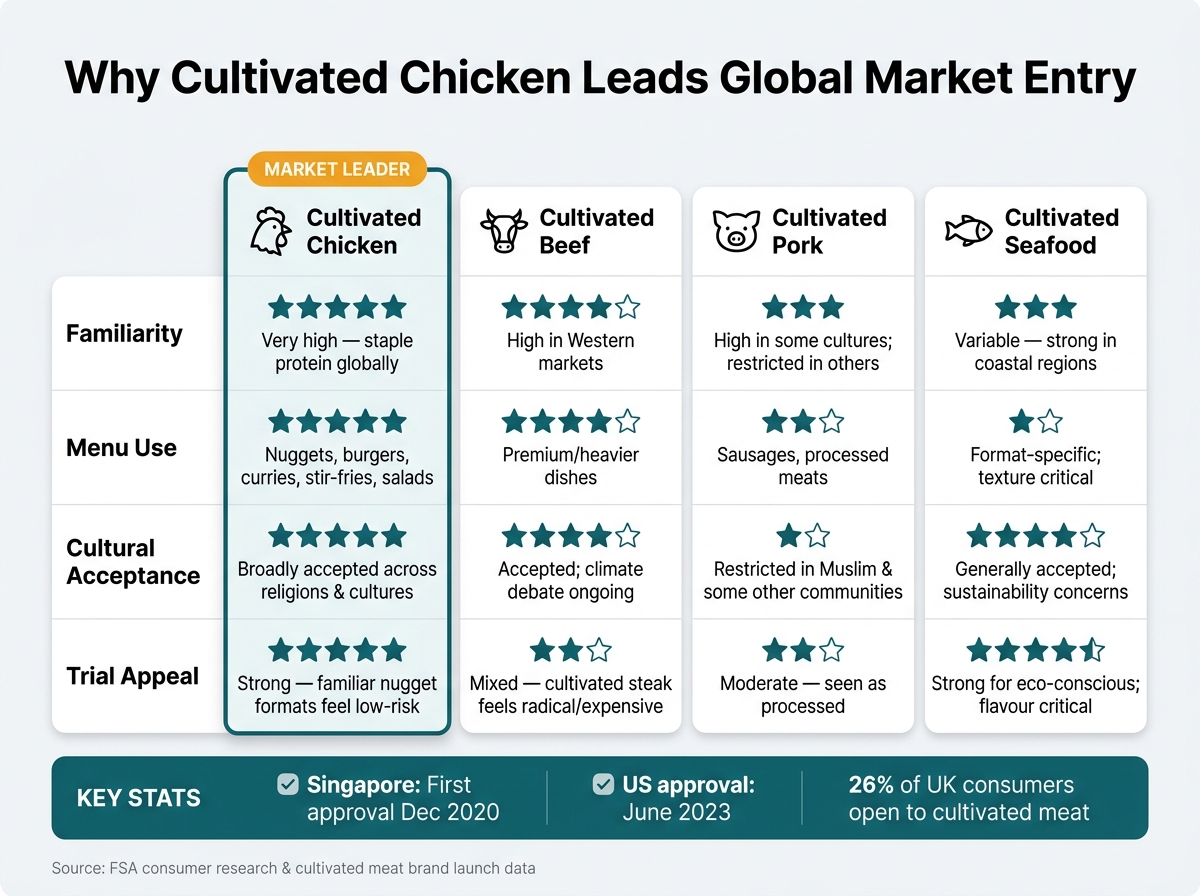
Cultivated Chicken vs Other Meats: Why Chicken Leads Global Market Entry
The first approvals have followed the same pattern: cultivated chicken goes first. That usually comes down to one thing: chicken is the lower-risk launch option.
Here’s how cultivated chicken stacks up against other species when a brand is planning its first move into a new country:
| Factor | Cultivated Chicken | Cultivated Beef | Cultivated Pork | Cultivated Seafood |
|---|---|---|---|---|
| Familiarity | Very high; a staple protein in many regions | High in Western markets; often tied to steaks and mince | High in some cultures; lower where religious or cultural limits apply | Variable; strong in coastal regions, but not always a daily staple |
| Menu use | Extremely versatile: nuggets, burgers, curries, stir-fries, salads | Versatile but often suited to premium or heavier dishes | Common in sausages and processed meats, but less used in premium pilots | Often format-specific (fillets, sushi, fish fingers); texture is critical |
| Cultural acceptance | Broadly acceptable across many religions and cultures where meat is eaten | Accepted, but more debate around climate and health | Restricted in Muslim and some other communities | Generally accepted, though concerns about overfishing or contaminants can shape perception |
| Trial appeal | Strong; familiar formats like nuggets make a first bite feel low-risk | Mixed; a cultivated steak can feel more radical or expensive | Moderate; often seen as processed or less healthy | Strong among sustainability-minded consumers; flavour and texture are critical |
In practice, that makes chicken the easiest species to test first in a new market.
It’s a simple point, but an important one. Chicken feels familiar and low-risk. A cultivated steak, by contrast, can feel pricier, more demanding, and less familiar from the start.
That helps explain why early launches often begin with chef-led tastings, restaurant service, or hybrid retail products. These formats give brands room to introduce the product carefully, while letting kitchens and diners try it in a setting that feels controlled.
Brands have leaned into that playbook with chicken. UPSIDE Foods launched at Bar Crenn, a Michelin-starred venue in San Francisco, serving cultivated chicken in a tasting menu format.[26][60] GOOD Meat also moved from restaurant service into retail in Singapore.[13][12][9][16] Each step helped build familiarity and gave the companies useful data before a more complex rollout.
Chicken leads because it lowers risk for brands, kitchens, and shoppers all at once.
The same pattern is likely to matter in the UK, where awareness is still low and approval has not yet arrived. The Food Standards Agency has found that around 26% of UK consumers are generally willing to include cultivated meat in their diet.[2][61] Cultivated Meat Shop is helping close that knowledge gap by using cultivated chicken as the clearest and most relatable example when explaining chicken-first launches to UK shoppers.
Pros and cons of a chicken-first expansion strategy
Chicken makes sense as a first move. People know it, buy it often, and already have plenty of ways to cook and serve it. That gives cultivated meat brands a simpler starting point than a less familiar category would.
At the same time, the approach has clear limits. The table below breaks them down.
| Factor | Pro | Con |
|---|---|---|
| Consumer recognition | Chicken is a familiar, globally recognised protein, so shoppers already know how to use it. | Familiarity also means brands must explain the production method, not just the product. |
| Menu use | It fits nuggets, strips, burgers, sandwiches, bowls, salads, and curries, so foodservice teams can use it in existing recipes. | Early products are still mostly ground or hybrid formats, while structured fillets and other whole cuts remain technically harder to produce. |
| Trial barrier | Familiar formats lower the psychological barrier to a first bite. | One review found that about 65.3% of consumers would try Cultivated Meat, but only 31.5% would eat it regularly as a replacement for farmed meat [62][63]. |
| Scaling potential | Chicken is one of the most standardised protein categories globally, so demand exists at volume. | Production is still far below the volumes needed for mainstream pricing. |
| Premium-price risk | A premium price can signal quality and sustainability credentials. | Chicken is usually affordable, so high prices can slow repeat purchase [62]. |
| Differentiation | Sustainability and animal welfare narratives are clear and persuasive. | Marketing still relies heavily on education and trust-building rather than novelty alone. |
| Regulatory dependence | Singapore and the US have set important precedents for cultivated chicken [4][1]. | Expansion stops until each market grants approval [64][17]. |
You can see these limits in actual market launches. GOOD Meat and UPSIDE Foods show both the upside and the friction. Their US approvals in 2023 [4][1] backed up the idea that chicken is the simplest place to begin. But progress after approval has still been held back by scale and price.
GOOD Meat’s retail product in Singapore, GOOD Meat 3, makes that pretty plain. It blends just 3% cultivated chicken with plant proteins and was sold at S$7.20 for a 120 g pack [12]. That works as a short-term fix. It also shows how tight production economics still are.
SuperMeat and Vital Meat follow the same playbook: begin with the meat category people recognise fastest, and use that familiarity to reach the broadest early audience. The catch is simple enough. A chicken-first plan can only take brands so far if price stays high, output stays low, and shoppers still need a lot of explanation before they come back for a second purchase.
Conclusion
Cultivated chicken is leading brand expansion for a simple reason: people already know it. It fits easily into familiar dishes, works across lots of menu formats, and gives brands a more straightforward way onto existing menus. That’s why chicken so often shows up first in launch plans across the category.
The brands covered in this article point in the same direction. GOOD Meat, UPSIDE Foods, SuperMeat and Vital Meat have each used chicken as their starting point to prove taste, build trust and enter new markets.
At the same time, the roadblocks are plain to see. High prices, low output and the need to keep educating shoppers are still slowing adoption at scale.
In the UK, fewer than 2% of consumers correctly understand what Cultivated Meat means [65]. That gap matters. Cultivated Meat Shop helps explain Cultivated Meat in a clear, practical way for shoppers who are most likely to come across cultivated chicken first.
For now, chicken remains the easiest first step into Cultivated Meat.
FAQs
Why is chicken usually launched first?
Cultivated chicken often comes first because people already know it well, and it tends to be less complex to make than other proteins.
Its softer, more even texture also makes it a good fit for familiar products like nuggets, patties and sausages. Those formats are easier to refine, scale and test in restaurants before moving into supermarket shelves.
Why are early products often hybrid or processed?
Early products are often hybrids. Mixing Cultivated Meat with plant-based proteins helps cut production costs, which can make these products more affordable for shoppers. It can also help with texture and flavour.
There’s another reason, too. Using a small share of cultivated cells makes it easier for companies to bring out familiar foods like nuggets, sausages and burgers, without needing the more difficult tissue engineering required for whole cuts.
What is stopping cultivated chicken from becoming mainstream?
Several hurdles are holding back cultivated chicken in the United Kingdom. The biggest ones are strict regulatory approval, high production costs, and technical issues around texture and moisture retention.
That means the challenge isn't just making cultivated chicken in a lab. It also has to pass tight checks, reach a price people can live with, and deliver the kind of bite and juiciness people expect from chicken on their plate.
Public perception is another sticking point. Some consumers question the science, see it as unnatural, or want to protect farming as they know it. That reaction isn't hard to understand. Food is personal, and when something new shows up, people often pause before they dig in.
Cultivated Meat Shop tries to close that gap by sharing clear, science-backed information that helps people understand what cultivated chicken is, how it's made, and why it matters.


