

Cultivated seafood may cost more than cultivated chicken at first - but that isn’t certain. I’d compare prices per 100 g and per serving, not just per pack.
Cultivated meat and seafood are grown from animal cells rather than obtained through slaughter. Here’s what I’d keep in mind:
- Species: Salmon, tuna and prawns each need their own cell-development work. Chicken may have a head start with simpler products such as nuggets.
- Format: Seafood cakes, fillings and plant blends may arrive before whole fillets, which need more complex structure.
- Price: Better yields and larger production volumes could cut costs, but neither guarantees lower shop prices.
- UK availability: I’d check the exact product’s authorisation, ingredients, cultivated content, allergens, storage and cooking instructions. <u>An application is not approval</u>, and rules differ between Great Britain and Northern Ireland.
My takeaway? Judge the product, not just the species. There’s no confirmed launch order - and no promise that prices will match conventional meat or seafood.
Cost drivers of cultivated meat production
sbb-itb-c323ed3
How Species Affect Production Costs
Developing a process for each species may push up early seafood prices, on top of costs for media, bioreactors, energy, staff, harvesting and processing. Regulatory approval in Great Britain adds costs too: developers must show cell identity, safety, composition and batch consistency.[6][5]
Why Salmon, Tuna and Prawns Need Different Cells
A process developed for one species cannot simply be copied to another. Developers must match cells, growth media and edible support structures to the product they want to make. These choices affect both launch timing and cost.[7][9]
- Salmon: Muscle and fat characteristics influence development for flakes, portions or fillets.
- Tuna: Distinctive texture and colour add development demands; minced products may be more practical initially.
- Prawns: Crustacean cells need tailored conditions; formed pieces or blended preparations may be likely early formats.[7][9]
Better cell growth does not always mean lower costs. Complex structuring or smaller production volumes can cancel out those gains. Lower temperatures may cut energy use, but the savings depend on media use, contamination control and how much saleable product each batch yields.
This species-by-species work helps explain why seafood may initially cost more than chicken.
Why Chicken Could Cost Less First
Chicken may reach lower prices sooner because developers have more research and cell-development work to draw on. Familiar formed products also need less complex tissue organisation.
Every species still needs controlled temperature, oxygen and acidity, along with suitable equipment and quality checks. Better-performing cells, cheaper food-grade media, automated monitoring and fewer failed batches could cut early production costs. Larger tanks alone cannot guarantee savings.
Production cost and shelf price are different: the sales channel and pack format also affect what shoppers pay. Compare £ per 100 g and £ per serving, rather than taking a higher launch price as proof that a species must cost more to produce.
Why Prepared Seafood May Arrive Before Fillets
The first seafood products may come in formed portions rather than fillets, much like early chicken products.
Prepared formats can use seafood Cultivated Meat as one ingredient, with oils, starches and binders adding richness, moisture and shape. Using less Cultivated Meat per serving can help control costs, but doesn’t guarantee a cheaper product.
Prepared Portions Compared with Whole Fillets
| Feature | Prepared portions | Whole fillets |
|---|---|---|
| Structure | Minced, blended, layered or emulsified; supporting ingredients provide shape and binding | Continuous, species-specific muscle structure with aligned fibres |
| Cost drivers | Cultivated Meat content, recipe ingredients, forming, cooking and packaging | Cell production, scaffolding, tissue formation, fat distribution and consistency |
Whole fillets need more than the right flavour. They also need to reproduce the structure and taste of fish: aligned fibres, connective tissue and fat. Getting these elements to hold together in a stable fillet is difficult.
Moisture control and cooking performance also need development and testing. The fillet must cook through without drying out or falling apart.
Premium sushi-style portions might launch in limited volumes, but premium positioning does not mean simpler production.
These are possible formats, not a confirmed launch order. For shoppers, what matters is whether the product is authorised and whether its label clearly explains what it is and how much Cultivated Meat it contains.[5][11]
What UK Shoppers Should Check
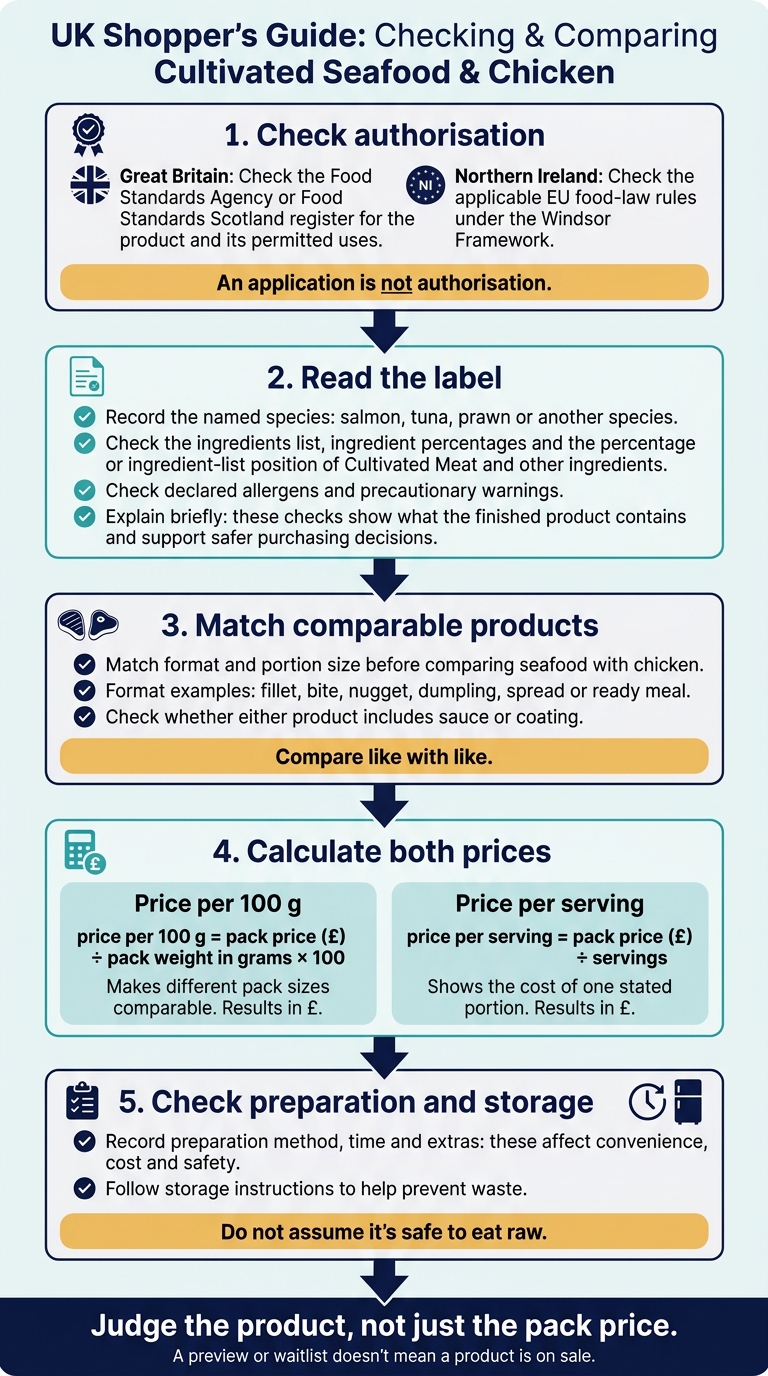
How to Compare Cultivated Seafood and Chicken
When seafood Cultivated Meat reaches UK shops, check its authorisation, label and unit price before comparing it with chicken.
Check Authorisation, Ingredients and Cooking Instructions
In Great Britain, check the Food Standards Agency or Food Standards Scotland register for the exact product and its permitted uses. An application is not authorisation. In Northern Ireland, check the applicable EU food-law rules under the Windsor Framework.[3][10][16]
Once you’ve confirmed authorisation, read the label to see what the product contains. Check the ingredients list, ingredient percentages, declared allergens and precautionary warnings, as well as storage instructions and the cooking method. Do not assume it’s safe to eat raw.[12][13][14][15]
Compare Prices per 100 g and per Serving
After checking the label, compare prices on a like-for-like basis.
Calculate price per 100 g = pack price ÷ pack weight in grams × 100, and price per serving = pack price ÷ servings. When comparing seafood with chicken, match the format and portion size, and check whether either product includes sauce or coating.
| Check | What to record | Why it matters |
|---|---|---|
| Unit price | Price per 100 g | Makes different pack sizes comparable |
| Serving price | Pack price divided by stated servings | Shows the cost of one stated portion |
| Species | Salmon, tuna, prawn or another named species | Production and formulation costs may differ |
| Ingredient proportions | Percentage or ingredient-list position of Cultivated Meat and other ingredients | Shows what the finished product contains |
| Format | Fillet, bite, nugget, dumpling, spread or ready meal | Helps avoid comparing unlike products |
| Preparation | Method, time and extras | Affects convenience, cost and safety |
| Storage | Required conditions | Helps prevent waste |
| Allergens | Declared allergens and precautionary warnings | Supports safer purchasing decisions |
Conclusion: Judge Each Product on Its Own
Seafood may cost more at first because each species needs its own development work, and some formats are harder to make than others.[8][17]
Better yields, simpler recipes and larger production volumes could bring costs down. But there’s no guarantee that chicken will launch first or that prices will eventually match those of conventional products.
Judge each product on more than its pack price. Look at the species, format, portion size, ingredients and preparation needs. Compare prices per 100 g and per serving, and check authorised UK availability: (use our availability checker for updates) a preview or waitlist doesn’t mean a product is on sale.[5][6]
FAQs
Will seafood Cultivated Meat offer the same omega-3 benefits as fish?
Yes, seafood Cultivated Meat is designed to provide the protein and omega-3 fatty acids people expect from conventional fish. Carefully controlled production conditions also let manufacturers fine-tune its nutrient profile. This could increase levels of healthy fats, such as omega-3s, beyond those typically found in conventional fish.
How can I tell whether Cultivated Meat is good value?
Look for proof that production is efficient and delivers more saleable kilograms, rather than just using bigger equipment. Low yields, costly growth media and unstable or expensive cell lines can all keep prices high.
Check what the price includes. Forecasts may leave out packaging, chilled delivery, retail margins and launch costs. Early products are likely to sell at premium prices, with costs falling as production scales up. [1][2][3][4]
Can I eat seafood Cultivated Meat if I have a fish allergy?
If you have a fish allergy, the corresponding seafood Cultivated Meat product may not be safe for you. Growing it in a controlled setting doesn’t change its origin: it still comes from animal cells.
UK regulators will require safety assessments that cover allergenicity, alongside mandatory, clear allergen labelling. Until further clinical guidance is available, treat these products with the same caution as conventional seafood.


